
Google Just Launched Agent2Agent — An Open Protocol Enabling AI Agents to Collaborate Seamlessly

Google Launches Agent2Agent (A2A): An Open Protocol for AI Agent Collaboration
Google is rolling out the Agent2Agent (A2A) Protocol, a new open standard that allows AI agents to communicate and collaborate—regardless of who built them, what framework they use, or where they’re deployed. If Model Context Protocol (MCP) gave agents a structured way to access tools and data, A2A gives them a structured way to work together, transforming isolated agents into cohesive digital teams.
This is perhaps the strongest signal yet that the AI industry is moving toward standardizing how autonomous systems interact in real-world environments.
Key Highlights:
✅ Open and Secure: A2A is an open protocol built for secure, cross-platform communication between agents.
🤝 Backed by 50+ Major Partners: Including Salesforce, Atlassian, Deloitte, SAP, Box, LangChain, and more.
🔗 Complementary to MCP: While MCP standardizes agent-to-tool interaction, A2A focuses on agent-to-agent collaboration.
🏢 Enterprise-Ready: Designed for complex use cases with support for authentication, real-time updates, streaming, and long-running workflows.
🌐 Multimodal and Flexible: Supports text, audio, video, and interactive content for rich, adaptive communication.
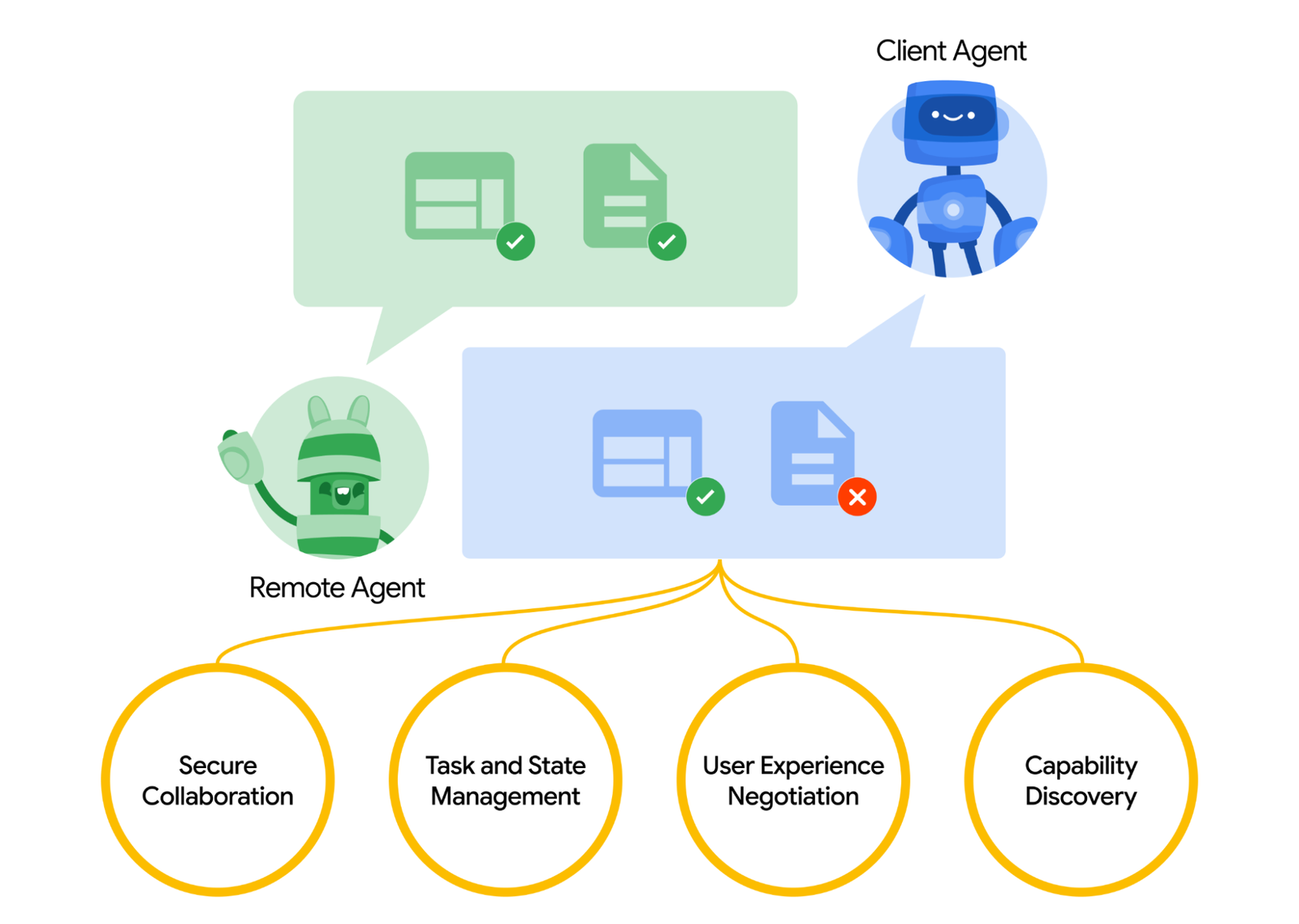
Think of A2A as a lingua franca for agentic AI—a shared communication layer that enables agents to:
Advertise capabilities via standardized Agent Cards
Negotiate user experience based on content type (text, markdown, video, etc.)
Coordinate complex tasks, from booking a meeting to orchestrating a multi-day hiring process
Handle real-time updates and human-in-the-loop interactions
From day one, A2A has been engineered with enterprise deployment in mind—providing the structure needed to move from experimentation to scalable, production-ready multi-agent systems.
In a world where AI agents will inevitably span platforms, models, and vendors, A2A offers a foundation for unified, secure, and intelligent collaboration.
A2A is launching with support from more than 50 major players across tech and consulting—including SAP, PayPal, MongoDB, ServiceNow, LangChain, and BCG—highlighting strong industry momentum toward interoperable agent ecosystems. For businesses building with AI, the potential is huge: instead of being locked into a single vendor’s stack or writing brittle glue code to connect agents across HR, CRM, or supply chain systems, A2A offers a unified, open standard. Just as HTTP unified the web, A2A is poised to do the same for the emerging world of AI agents.
Google frames A2A as a natural complement to Anthropic’s Model Context Protocol (MCP), which focuses on structured tool and data access. While MCP connects agents to APIs and services, A2A enables agents to interact and collaborate directly. As Google puts it: if MCP is the socket wrench, A2A is the conversation between the mechanics as they figure out what’s wrong.
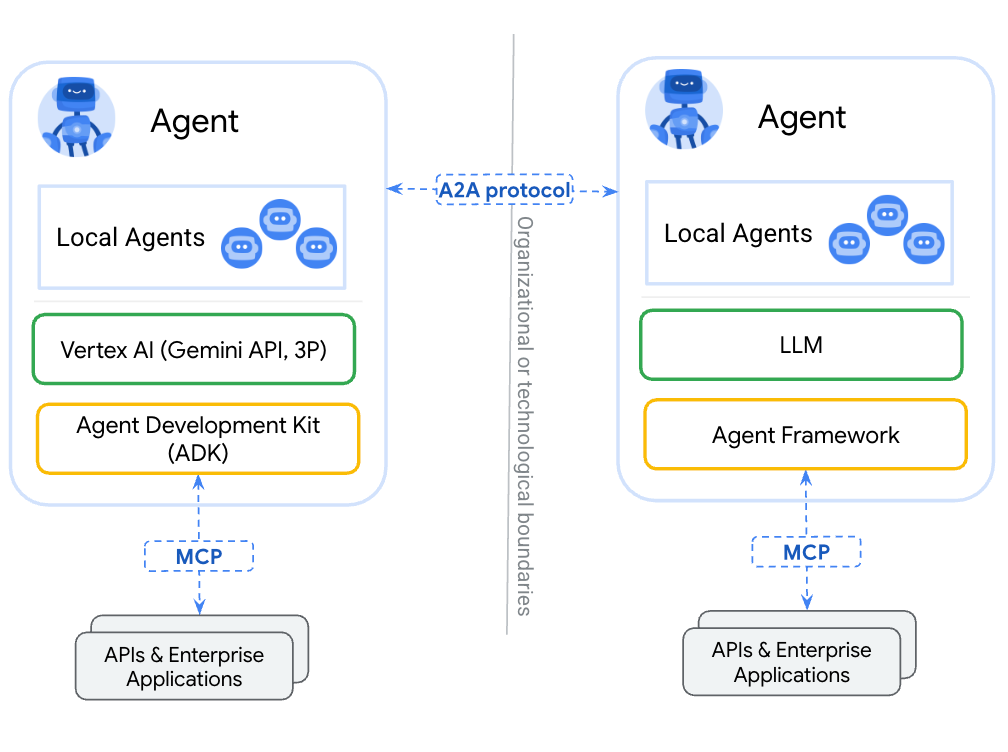
A2A is purposefully built to support opaque agents—those that don’t reveal their internal memory or reasoning processes. This design is critical for enterprise environments where security, modularity, and vendor abstraction are top priorities. Rather than syncing internal states, agents communicate through well-defined “Tasks”, which include inputs, instructions, real-time status updates, and final outputs known as “Artifacts.” All communication flows via standardized formats like HTTP, JSON-RPC, and SSE, enabling both reliability and compatibility.
The initial specification is live and open source, with SDKs, sample agents, and example apps already available for frameworks like Google’s ADK, LangGraph, CrewAI, and Genkit. Google is inviting the broader developer community to contribute as it moves toward a 1.0 production release later this year.
If A2A continues to gain momentum—and early adoption suggests it will—it could become a foundational layer of the AI ecosystem, much like Kubernetes standardized cloud-native applications or OAuth unified secure cross-platform access. By solving the agent interoperability problem at the protocol level, A2A dramatically reduces the friction of connecting agents from different vendors, enabling businesses to orchestrate a true digital workforce.
The protocol is currently open source on GitHub, and with a production-ready launch on the horizon, A2A is shaping up to be a must-watch standard for companies investing in AI at scale.