
What Are AI Agents and Why Do They Matter?

The difference between traditional AI models and AI agents may seem subtle, but it’s significant. When interacting with an AI model like Gemini, O1, or Sonnet, we’re essentially having one-off exchanges: we provide input, the model processes it, and returns output. While these interactions can be quite advanced, they are fundamentally reactive and stateless. Each response is independent, with no true continuity or capability for the model to take autonomous action.
AI agents, on the other hand, are autonomous systems designed to perceive their environment, make decisions, and take actions to achieve specific goals—while continuously maintaining context and adjusting their approach based on outcomes.
This may seem like a small difference, but it signifies a fundamental shift in how AI systems operate and what they can accomplish.
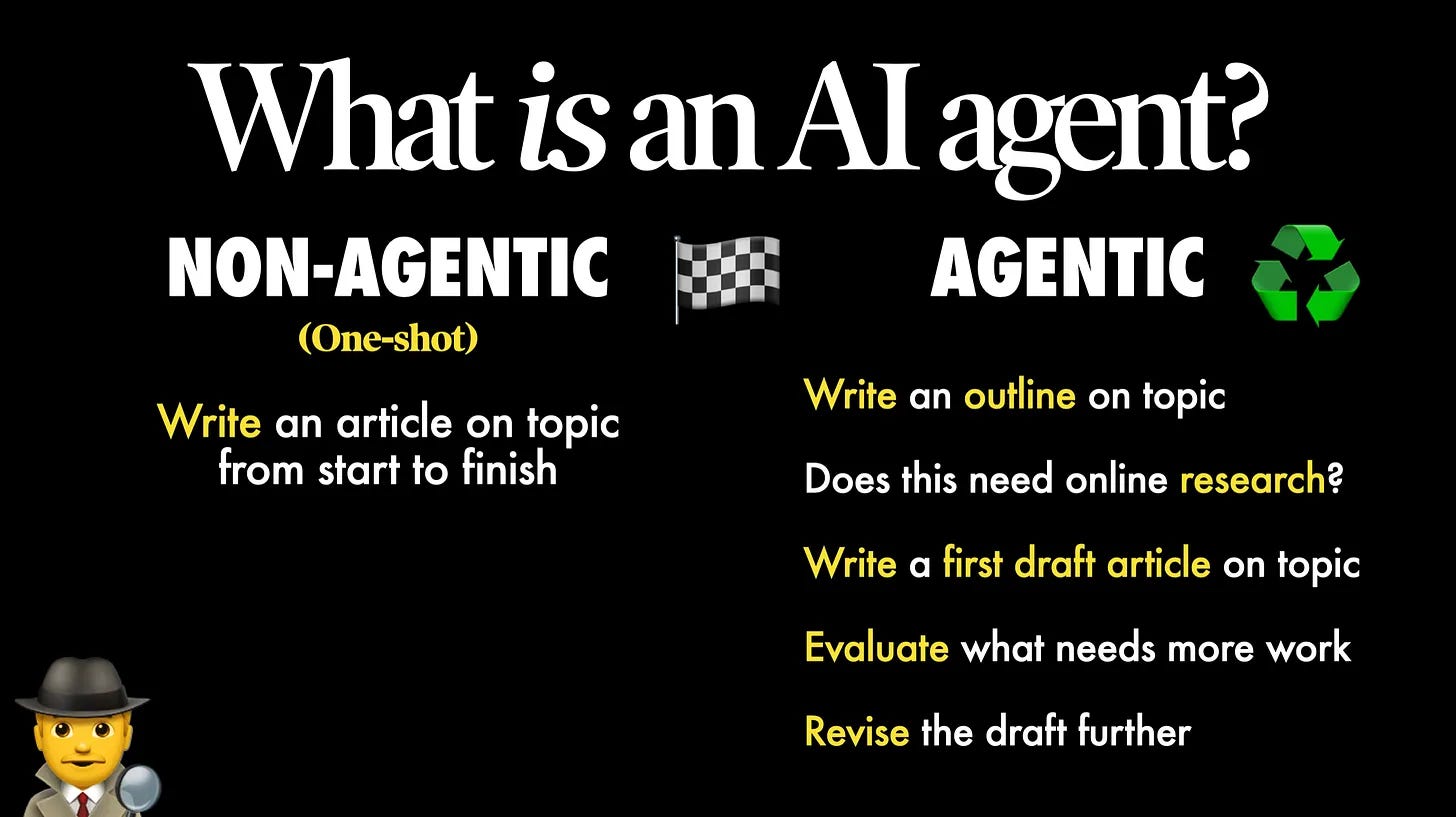
Take how many of us use AI chat interfaces today, for example. You might ask ChatGPT to write an article from start to finish and receive a one-time response. To refine it, you likely need to do some work yourself. In contrast, an agentic version would be more dynamic: an agent might start by creating an outline, decide if research is required, write a draft, evaluate whether it needs improvements, and even revise itself. Let’s explore a few examples of agents in action.
AI agents, on the other hand, are autonomous systems designed to perceive their environment, make decisions, and take actions to achieve specific goals—while continuously maintaining context and adjusting their approach based on outcomes.
This may seem like a small difference, but it signifies a fundamental shift in how AI systems operate and what they can accomplish.
Take how many of us use AI chat interfaces today, for example. You might ask ChatGPT to write an article from start to finish and receive a one-time response. To refine it, you likely need to do some work yourself. In contrast, an agentic version would be more dynamic: an agent might start by creating an outline, decide if research is required, write a draft, evaluate whether it needs improvements, and even revise itself. Let’s explore a few examples of agents in action.
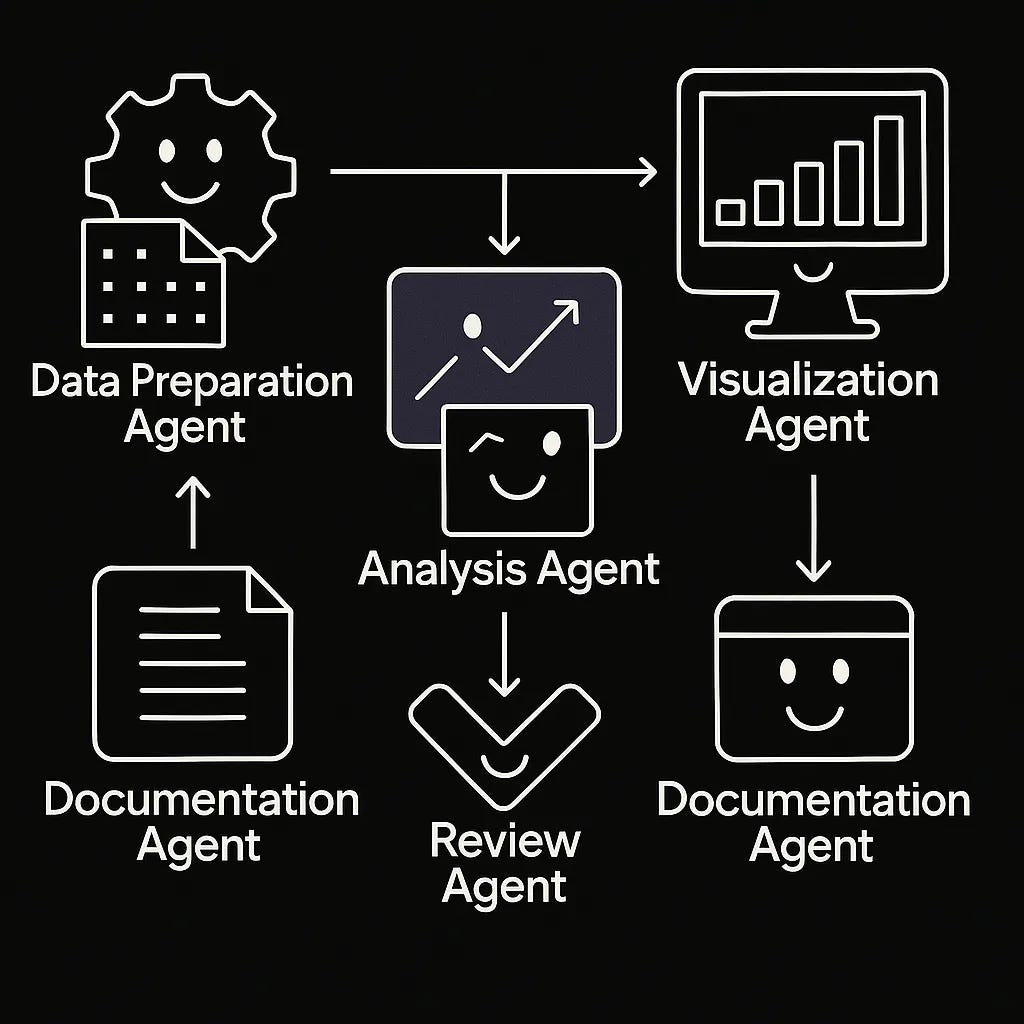
Each agent in this workflow maintains its own context and area of expertise while collaborating with others through structured protocols.
They can address edge cases dynamically—if, for example, the analysis agent identifies data quality issues, it can request specific cleanups from the preparation agent. Similarly, if the visualization agent spots an interesting pattern, it can suggest additional analyses to dive deeper. This is more than just having a consultant who offers advice—it’s like having an entire team of specialists seamlessly working together to complete the task.
Now, comparing one-shot prompts to agents: when it comes to AI for code generation, we’re mostly accustomed to the 'prompt and response' method. You provide a prompt like "write code that does X," and the AI returns a block of code.
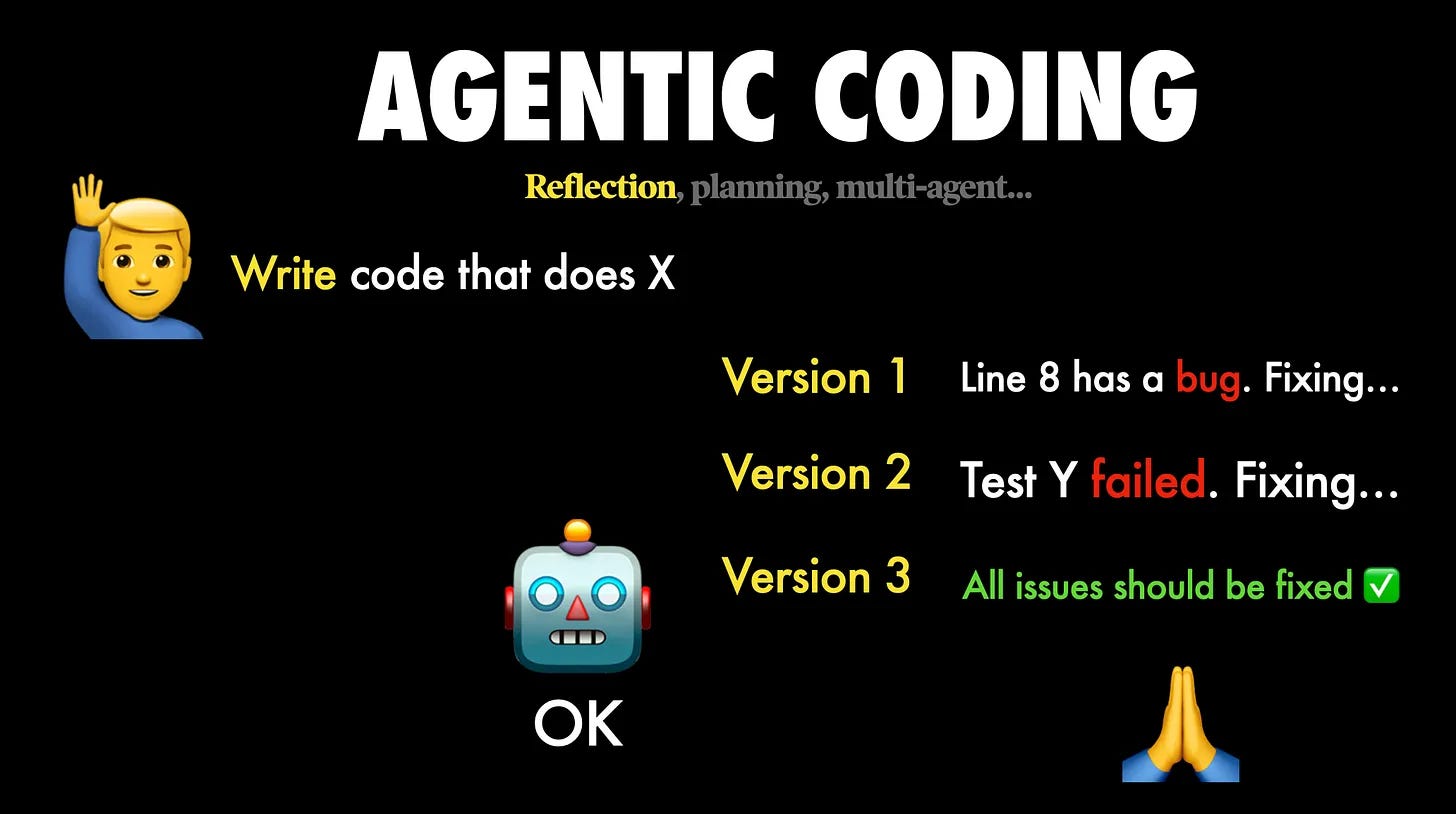
An agent takes a more refined approach to problem-solving. It can outline the logic, review the code, run tests, detect bugs, and then reassess and fix any issues if something doesn’t work. This iterative process mirrors how engineers approach tasks, delivering superior results. The AI becomes a true collaborator, not just a generator of outputs.
This autonomy and capacity to take action set agents apart from even the most advanced language models. It enables the automation of tasks that were previously too small or complex for traditional automation—everything from organizing files across systems to monitoring data feeds for specific patterns, and coordinating intricate workflows across multiple applications.
Why am I personally excited about agents?
Agents have the flexibility to tackle work that organizations previously couldn’t afford to address—not by replacing existing systems or people, but by complementing them.
Agents shift the paradigm from software as a tool to software as a worker. This represents a new type of relationship between enterprises and their technology stack.
Agents may decouple software value from end-user volume. You’re no longer constrained by the workload your human team can handle.
Use cases like “Deep Research” and agent-driven coding have already saved me a tremendous amount of time, freeing me up to focus on what AI can’t handle.
The Emergence of Standardized Protocols for AI Agent Interoperability
For AI agents to operate autonomously and collaboratively, standardized communication protocols are essential. These protocols ensure seamless interoperability and enable the creation of sophisticated multi-agent systems. Without such standards, ecosystems could become fragmented, preventing complex task automation and cross-platform collaboration. Two key developments are worth noting here:
Model Context Protocol (MCP):
Introduced by Anthropic, MCP is an open standard designed to link AI models to external tools and data sources (think of it as "USB-C for AI integrations"). It allows AI assistants to directly access and interact with various datasets, enhancing their ability to retrieve information and execute tasks. For example, MCP enables an AI assistant to connect to platforms like GitHub to create repositories and manage pull requests efficiently. Learn more about MCP and its practical applications here.Agent2Agent Protocol (A2A):
Recently announced by Google, A2A is an open standard that facilitates seamless communication and collaboration between AI agents from different vendors and frameworks. This protocol allows agents to securely exchange information and coordinate actions across various enterprise platforms, fostering interoperability and improving automation.
Beyond Simple Automation: Understanding Agent Capabilities
AI agents offer capabilities that go well beyond basic automation scripts or chatbots. They can:
Maintain Persistent Context and Memory:
Agents can remember past interactions, allowing them to learn from experience and adapt their approach over time.Interact with External Systems:
Whether through APIs, web browsers, or direct system interactions, agents can seamlessly integrate with and use external tools.Break Down Complex Goals:
Agents can deconstruct large, complex goals into manageable sub-tasks, executing them in a logical sequence.Monitor Progress and Adjust Strategies:
Agents track their progress and can modify their strategies based on real-time results and feedback.Collaborate with Other Agents:
Each agent can specialize in different aspects of a larger task, working together to achieve a common objective.
This combination of capabilities empowers agents to tackle complex, multi-step tasks that traditional AI systems would struggle to manage.
Agent Patterns and Architectures: The Building Blocks of Autonomous Systems
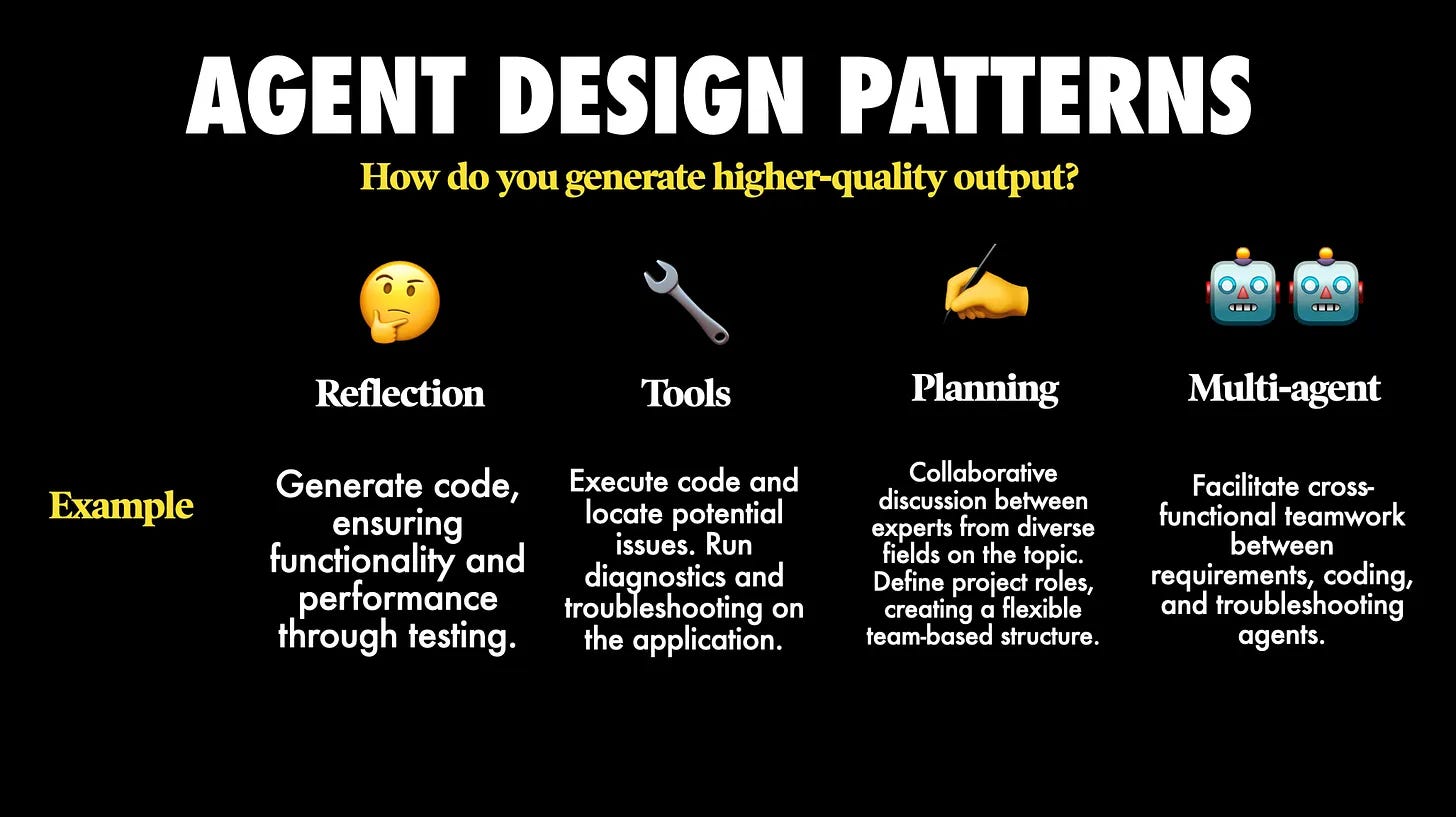
The rise of AI agents has led to the development of various architectural patterns, each addressing different aspects of autonomous decision-making and action-taking. Understanding these patterns is essential for comprehending both the current capabilities and limitations of agent systems, as well as their potential for future growth and evolution.
Tool use and integration
The most fundamental pattern in agent architecture is tool use - the ability to interact with external systems and APIs to accomplish tasks. This is about understanding when and how to use different tools effectively. Modern agents can interact with everything from database systems to development environments, but what's particularly interesting is how they choose which tools to use and when.
For instance, when an agent is tasked with analyzing sales data, it might need to:
Use file system APIs to access raw data
Employ data processing libraries for analysis
Leverage visualization tools to create reports
Utilize communication APIs to share results
The sophistication lies not in the individual tool interactions, but in the agent's ability to orchestrate these tools coherently toward a goal. This mirrors human cognitive processes - we don't just know how to use tools, we understand when each tool is appropriate and how to combine them effectively.
Memory and context management
Perhaps the most significant architectural challenge in agent systems is managing memory and context. Unlike stateless LLM interactions, agents need to maintain an understanding of their environment and previous actions over time. This has led to several innovative approaches:
Episodic Memory: Agents maintain a record of past interactions and their outcomes, allowing them to learn from experience and avoid repeating mistakes. This isn't just about storing conversation history; it's about extracting and organizing relevant information for future use.
Working Memory: Similar to human short-term memory, this allows agents to maintain context about their current task and recent actions. This is crucial for maintaining coherence in complex, multi-step operations.
Semantic Memory: Long-term storage of facts, patterns, and relationships that the agent has learned over time. This helps inform future decisions and strategies.
Hierarchical planning and execution
One of the most sophisticated patterns emerging in agent architecture is hierarchical planning. This approach breaks down complex goals into manageable sub-tasks, creating what amount to cognitive hierarchies within the agent system. This mimics how human experts approach complex problems - breaking them down into smaller, manageable pieces.
The hierarchy typically consists of:
Strategic planning: High-level goal setting and strategy development
Tactical planning: Breaking strategies into specific, actionable tasks
Execution planning: Determining the specific steps needed for each task
Action execution: Carrying out the planned steps and monitoring results
This allows agents to manage complexity that would be overwhelming with a flat architecture. For instance, an agent tasked with "improve our website's performance" might:
At the strategic level: Decide to focus on load time and user experience
At the tactical level: Plan to optimize JavaScript / long tasks, compress images and improve server response time
At the execution level: Detail specific steps for each optimization
At the action level: Actually implement the changes and measure results
Multi-Agent systems and collaboration
Perhaps the most intriguing pattern emerging in agent architectures is the development of multi-agent systems. These systems distribute cognitive load across multiple specialized agents, each handling different aspects of a complex task. This pattern has emerged as a natural solution to the limitations of single-agent systems, much as human organizations evolved to handle complex tasks through specialization and collaboration.
Microsoft's AutoGen and the open-source CrewAI framework exemplify this approach, allowing developers to create teams of agents that work together on complex tasks. A typical multi-agent system might include:
A coordinator agent that manages overall task flow and delegation
Specialist agents with deep knowledge in specific domains
Critic agents that review and validate work
Integration agents that handle communication between other agents and external systems
The power of this approach lies in its ability to break down complex cognitive tasks into manageable pieces while maintaining coherence through structured communication and collaboration protocols. For example, in a software development context, you might have:
A requirements agent that interfaces with stakeholders and maintains project goals
A design agent that creates technical specifications
Multiple development agents working on different components
Testing agents that verify functionality
Documentation agents that maintain technical documentation
The interaction between these agents goes beyond just message passing; it involves advanced protocols for negotiation, consensus-building, and conflict resolution. This approach mirrors human organizational structures, but with the added benefits of flawless information sharing and consistent execution of agreed-upon protocols.
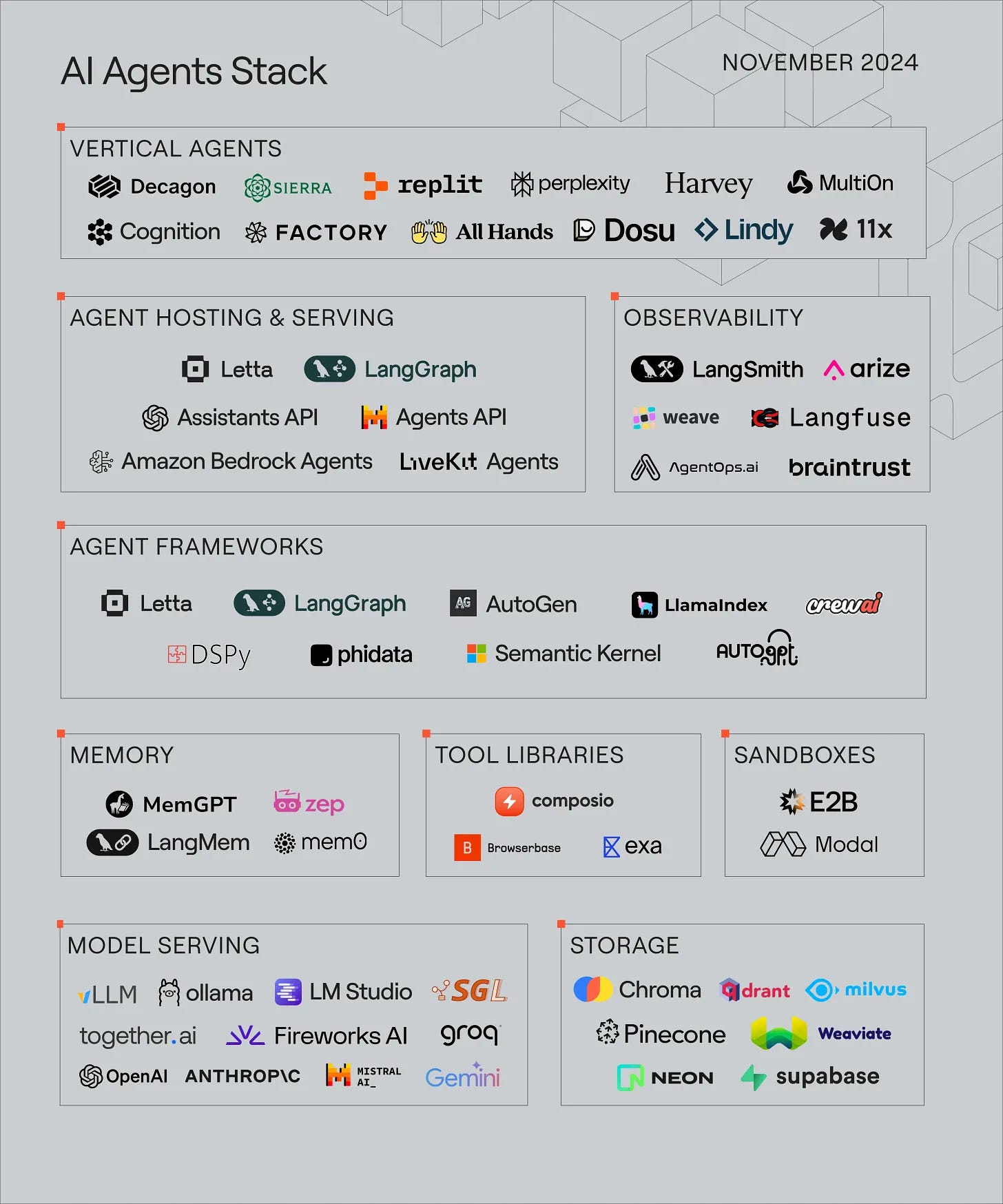
The Browser Agent Ecosystem: Bridging AI and the Web
The rise of browser-based AI agents is, in my opinion, one of the most groundbreaking developments in the agent ecosystem. These agents can interact with web interfaces just like humans—navigating pages, filling out forms, extracting information, and executing complex workflows. This capability is a game-changer for web automation and interaction, unlocking possibilities that were once impractical or impossible.
The Current Landscape
The browser agent ecosystem is currently split into several distinct approaches, each with its own strengths and trade-offs:
Proprietary Solutions
Google’s Project Mariner is one example of a tightly integrated solution, built on top of Chrome and powered by Gemini. Though still experimental, it demonstrates the potential for browser agents to seamlessly integrate into our web experience. I had the privilege of working with Mariner to help bring their vision to life.
OpenAI's Operator takes a distinct approach by focusing on general-purpose web interaction through a model called the Computer-Using Agent (CUA). It stands out for its advanced vision and reasoning capabilities, allowing it to understand and engage with complex web interfaces. Integrated with GPT-4, it offers sophisticated decision-making, enabling it to handle intricate tasks such as booking travel arrangements or managing e-commerce transactions.
Open Source Alternatives
On the other side, projects like Browser Use and Browserbase's Open Operator are helping democratize browser automation capabilities.
Browser Use is an open-source initiative designed to allow AI agents to directly interact with web browsers, enabling the automation of complex web-based tasks. This tool empowers AI models to autonomously navigate websites, extract data, and perform a variety of web operations via an intuitive interface. It identifies and interacts with web elements without requiring manual configuration and is compatible with various large language models (LLMs).
Browserbase's Open Operator is an open-source tool that automates web tasks using natural language commands. It interprets user instructions and performs actions within a headless browser environment, simplifying complex web interactions. Open Operator utilizes Browserbase's cloud-based infrastructure for enhanced efficiency and scalability.
Skyvern leverages large language models (LLMs) and computer vision to automate browser-based workflows. It adapts to different web pages, performing complex tasks through simple, natural language commands. The team is also exploring ways to seamlessly integrate more third-party tools into the agent workflow.
These open-source solutions provide several key benefits:
Transparency: Users can inspect and modify the code, gaining a clear understanding of how the agent makes decisions.
Customization: Organizations can tailor the tools to fit their specific needs.
Cost Control: No reliance on proprietary API pricing structures.
Community Development: Continuous iteration and improvement through community contributions.
The Browserbase ecosystem, in particular, has gained traction with its Stagehand framework, which offers a strong foundation for building custom browser agents. This framework allows developers to create advanced automation workflows while maintaining full control over the entire stack.
Beyond Simple Automation
What makes browser agents especially compelling is their ability to exceed the capabilities of traditional web automation. As Aaron Levie aptly points out:
"AI agents that can spin up infinite cloud browsers aren’t for tasks we already handle well with APIs. They’ll be used for the long tail of tasks that we’ve never had the time or resources to wire up with APIs."
This insight highlights why browser agents are so valuable. Consider these examples:
Complex Research Tasks:
An agent can navigate multiple websites, cross-reference information, extract relevant data while preserving context, and synthesize findings into comprehensive reports—without the need for specific APIs or integration points.User Interface Testing:
Agents can systematically explore web applications, identify usability issues, test edge cases, and document bugs and inconsistencies, all while understanding the context and user experience principles.Content Management:
Agents can monitor multiple sites for changes, update content across platforms, ensure consistency in branding and messaging, and handle the tedious aspects of digital presence management.
These capabilities demonstrate how browser agents go beyond simple automation, transforming the way we manage and interact with web-based tasks.
The Browser Agent Ecosystem: Bridging AI and the Web
The rise of browser-based AI agents represents, in my view, one of the most significant advancements in the agent ecosystem. These agents are capable of interacting with web interfaces just like humans—navigating pages, filling out forms, extracting data, and executing complex workflows. This ability fundamentally transforms web automation and interaction, unlocking possibilities that were previously either impractical or impossible.
The Current Landscape
The browser agent ecosystem is currently divided into several distinct approaches, each offering its own strengths and trade-offs:
Proprietary Solutions
Google’s Project Mariner is one example—a highly integrated solution built on top of Chrome and powered by Gemini. Although still in the experimental phase, it illustrates the potential for browser agents to become a native part of our web experience. I’ve had the privilege of working with Mariner, helping to bring their vision to life.
Open Source Alternatives
On the other end, open-source projects like Browser Use and Browserbase’s Open Operator are helping to democratize browser automation.
Browser Use is an open-source project designed to allow AI agents to interact directly with web browsers, enabling the automation of complex web-based tasks. This tool lets AI models autonomously navigate websites, extract data, and perform various operations via an easy-to-use interface, without needing manual configuration. It's compatible with several large language models (LLMs), allowing for easy integration.
Browserbase’s Open Operator is another open-source tool that automates web tasks using natural language commands. It interprets user instructions and performs actions within a headless browser environment, streamlining complex web interactions. Open Operator utilizes Browserbase’s cloud infrastructure, enabling it to scale efficiently.
Skyvern and Advanced Automation
Skyvern uses large language models (LLMs) and computer vision to automate browser workflows. The system adapts to various web pages, executing complex tasks through simple natural language commands. Skyvern is also exploring ways to seamlessly integrate third-party tools into the agent workflow, enhancing its versatility.
The Value of Open Source Solutions
These open-source tools offer several advantages:
Transparency: Users can inspect and modify the code to understand exactly how the agent makes decisions.
Customization: Organizations can tailor the tools to their specific needs.
Cost Control: No dependence on proprietary API pricing.
Community Development: Rapid iteration and improvement through contributions from the open-source community.
Browserbase’s ecosystem has been particularly successful with its Stagehand framework, which provides a robust foundation for creating custom browser agents. This framework allows developers to build complex automation workflows while retaining full control over the entire stack.
Beyond Simple Automation
What sets browser agents apart is their ability to handle tasks beyond traditional web automation. As Aaron Levie points out:
"AI agents that can spin up infinite cloud browsers aren’t for tasks we already handle well with APIs. They’ll be used for the long tail of tasks that we’ve never had the time or resources to wire up with APIs."
This observation highlights why browser agents are so valuable. Here are some examples of their capabilities:
Complex Research Tasks:
An agent can navigate multiple websites, cross-reference information, extract relevant data while maintaining context, and synthesize findings into coherent reports—without requiring specific APIs.User Interface Testing:
Agents can explore web applications, identify usability issues, test edge cases, and document bugs and inconsistencies—all while understanding context and user experience principles.Content Management:
Agents can monitor multiple sites for updates, adjust content across platforms, ensure consistency in branding and messaging, and handle the repetitive aspects of digital presence management.
Challenges and Limitations: The Reality Check
While the potential of AI agents is vast, it's crucial to acknowledge the technical challenges and limitations they face. These issues must be addressed for agents to realize their full potential:
Technical Challenges
Reliability and Consistency
Agents can sometimes exhibit unpredictable behavior, especially in novel situations. This can manifest in:Hallucinations and False Confidence: Agents may make incorrect assumptions or execute actions based on misunderstood context.
Error Propagation: Small errors can compound, especially in multi-step tasks, and recovery from intermediate failures remains difficult.
Context Management
Managing accurate state over long sequences of operations, handling interruptions, and reliably managing concurrent tasks are all significant challenges.As Levie notes, "How do we ensure accuracy on results and not have incremental hallucination or mistakes at each step?" This remains a core challenge in agent development.
Security and Privacy Concerns
The autonomous nature of agents introduces significant security and privacy risks:
Access Control:
Agents require broad system access to be effective, which complicates traditional security models.Data Privacy:
Agents may handle sensitive data across multiple systems, raising concerns about privacy boundaries in complex workflows.Audit and Accountability:
Tracking agent actions for compliance and establishing accountability for their decisions is essential.
Economic and Practical Limitations
Computational Costs:
Running sophisticated agents requires significant computing power, and the cost per operation may be higher than traditional automation.Integration Overhead:
Adapting existing systems for agent interaction can be resource-intensive, requiring new agent-friendly interfaces and training.Skill Requirements:
Effective deployment of agents requires expertise in understanding their limitations and managing their operations.
The Path Forward: AI Agents in the Enterprise
AI agents are poised to transform not only how we automate tasks, but how we interact with technology. The shift to agent-driven processes represents a fundamental change in enterprise workflows, enabling new forms of automation that were previously unattainable.
As Levie suggests, the success of this transition will depend on our ability to collaborate with AI—“The next decade will be defined by how well we collaborate with AI—not just how smart it is.” This highlights the importance of creating frameworks that not only support AI's technical capabilities, but also help organizations fully integrate them into their operations.
The age of AI agents is unfolding now. The question isn’t whether they will transform how we work, but how we shape that transformation. To unlock their full potential, we must not only address the challenges but also reimagine what’s possible when software becomes a true autonomous partner.